
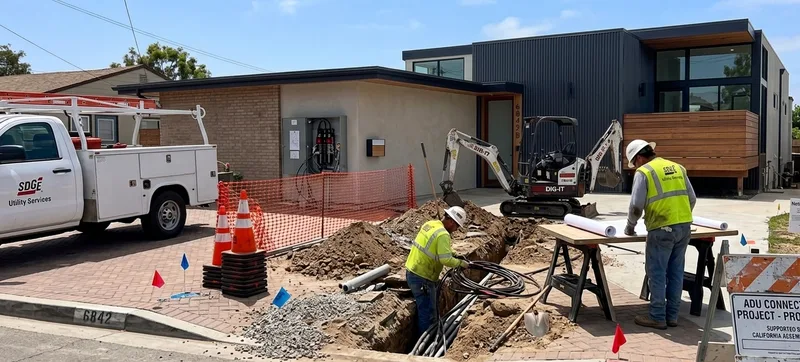
You've pulled your permits. Construction is finished. But your ADU is sitting idle because the power company hasn't shown up yet. It is a situation more California homeowners run into than most people realize, and a new bill working through the state legislature is designed to put an end to it.
The problem SB 1196 is trying to solve
State Senator Jerry McNerney recently introduced SB 1196, a bill aimed at one of the most persistent and underreported obstacles in ADU construction: getting the unit connected to electricity, water, and gas after the building work is complete.
Under the current rules, there is no statewide requirement for utility companies to complete service connections for ADUs within any specific timeframe. That gap has left some projects stalled for months, or even close to a year, after construction wraps. According to the senator's office, homeowners and builders across California have grown increasingly frustrated by delays that are entirely outside their control once the construction work is done.
The legislation would change that by establishing clear, enforceable deadlines for utilities and introducing financial penalties for companies that fail to meet them.
What the bill would require
According to the bill summary released by Senator McNerney's office, SB 1196 would introduce several concrete changes to the current process:
- Establish firm timelines for utility companies to complete ADU service connections
- Allow homeowners to submit a utility hookup request at the same time they apply for a building permit, getting the process started earlier
- Prohibit utilities from canceling a service connection application without the applicant's consent
- Create financial penalties for utilities that miss the required connection deadlines
Taken together, these provisions are intended to bring the same kind of accountability to the utility connection process that existing state law already applies to building permit review. The goal is predictability: homeowners should be able to plan around a reasonable, reliable timeline rather than waiting indefinitely for a third party to act.
Why utility delays hit ADU projects especially hard
For a large commercial development, a month of delay on utility connections is an inconvenience. For a homeowner who has just finished building a backyard ADU, it can mean months of deferred rental income, extended carrying costs, or an extended stretch of being unable to house a family member who was counting on moving in.
ADU projects often involve relatively modest utility upgrades compared to larger developments, which makes the length of some reported delays particularly hard to justify. A homeowner who has done everything right, secured permits, completed construction, and passed final inspections, should not face an open-ended wait for a utility connection before they can use the unit they built.
At Troia Construction, we try to get clients thinking about utility coordination as early as possible in the project process, precisely because delays at this stage can undermine an otherwise well-executed build. If SB 1196 passes, it would give that planning process a firmer foundation.
ADUs have become central to California's housing strategy
The context behind this legislation matters. California has seen ADU construction grow dramatically over the past decade. According to figures cited by Senator McNerney's office, the number of ADUs permitted statewide has risen from roughly 800 per year to approximately 30,000 annually. That growth reflects years of legislative effort to simplify permitting, limit local restrictions, and make ADU development more accessible to ordinary homeowners.
But as the volume of ADU projects has increased, the friction points that remain have become more visible. Permitting timelines are now regulated by state law. Local design restrictions have been significantly curtailed. The utility connection process has largely been left unaddressed, and SB 1196 represents the legislature's recognition that this gap needs to be closed.
Homeowners build ADUs for a range of reasons: rental income, housing for aging parents or adult children, and long-term property value. In every case, a unit that cannot be occupied because utilities have not been connected is a unit that is not serving anyone. The state has a clear interest in making sure that completed housing comes online as quickly as possible.
Where the bill goes from here
SB 1196 is expected to be taken up by a legislative committee in the coming months as part of California's 2026 session. If it advances and is signed into law, it would represent another meaningful step in the state's ongoing effort to remove the administrative and logistical barriers that slow housing construction from concept to occupancy.
For homeowners who are currently planning an ADU, it is worth following this bill's progress. Even if it does not pass in its current form, the attention the legislature is paying to utility connection timelines signals that this is an area where accountability is heading in one direction.
Utility hookups can delay an ADU project even after construction is fully complete. Ask your contractor early in the planning process about connection timelines for electricity, water, and gas in your specific jurisdiction. In some areas, getting that process started before your permit is even approved can meaningfully reduce the wait at the end of your build.